
FAQ

Frequently Asked Questions During Our Service

A short set of questions for premium eyewear brands evaluating OEM custom development, production execution, sample development, MOQ, NDA, and project timelines with DOON.


Crafting a pair of eyewear involves numerous detailed challenges across the whole production process. We address every technical difficulty with sophisticated manufacturing techniques, supported by rigorous multi‑stage quality inspections, to deliver reliable, high‑quality finished eyewear.

FAQ

Is DOON the right manufacturing partner for our brand?

DOON supports premium eyewear projects where material selection, engineering, finishing and production consistency matter. We work with acetate, titanium, stainless steel and combination frames, with selected special-material and craft projects reviewed individually. The starting point is your collection direction, market positioning, quantity and quality expectations—not simply the lowest unit price.

Are you a manufacturer, and where is production carried out?

DOON is a premium eyewear manufacturer founded in 2016 and based in Shenzhen, China. Our Shenzhen operation handles core engineering, sampling, production planning and main manufacturing. Selected projects may also involve ANNEAL Japan support. We clarify the proposed manufacturing route before the project proceeds.

Which processes are in-house, and which involve specialist suppliers?

Our work combines frame development and manufacturing with specialist sourcing for materials, components, lenses and selected surface treatments. Certain jewellery processes also involve specialist partners. The division of work depends on the construction; we can explain the relevant production steps and inspection responsibilities during project evaluation rather than describe every process as in-house.

Do you work with independent brands as well as established groups?

Yes. Project fit depends on a clear product direction, realistic purchasing budget, workable quantities and development expectations—not company size alone. For a new brand, we first establish the commercial and product brief. For an established team, we can begin with its technical files, approved samples and supplier requirements.

Can you help a fashion or lifestyle brand launch eyewear?

Yes. We can help translate a defined brand direction into eyewear through material selection, frame construction, branding details and sample development. Eyewear also needs its own fit, lens, durability and production requirements. A fashion reference or logo is a useful starting point, but it does not replace an eyewear development brief.

How can we assess your quality before committing to development?

Review relevant physical samples alongside the features that matter to your brand: surface feel, edge definition, hinge fit, lens fitting, alignment and assembly. Our Sample Box can support a focused evaluation. A factory visit or technical discussion can then help connect the visible quality with the manufacturing process behind it.

Which brands do you manufacture for? Can you share their products?

We protect customer confidentiality and do not confirm or disclose specific brand relationships without authorisation. We can discuss relevant manufacturing experience and share non-confidential samples or craft references suitable for your project. Your designs and commercial information should receive the same protection.

Can our team visit the factory or arrange an independent audit?

Factory visits and client-appointed inspections can be discussed in advance. Please share your proposed dates, team roles and the processes or documentation you need to review. Audit scope, access and timing need to be agreed while protecting other customers’ confidential work.

What is the difference between OEM Custom Development and OEM Production Execution?

OEM Custom Development is for brands with a clear creative direction that still need technical drawings, engineering and sample development. OEM Production Execution is for projects with approved designs, technical files or reference samples that need manufacturing review and controlled production. Both require agreement on specifications and sample approval before bulk production.

Can we start with sketches, reference images or AI-generated concepts?

Yes. These can establish the intended shape, proportions and visual details. They are not production-ready specifications: dimensions, fit, component interfaces, material thickness and construction still require engineering review. We assess the work needed to turn the concept into drawings and physical samples before confirming development scope and fees.

We already have CAD files and prototypes. Can you manufacture them?

We can review them for production feasibility. Please include dimensions, materials, components, finishes, lens requirements and the points that must remain unchanged. An existing prototype is valuable, but its construction and tolerances still need to be checked against the intended production process before cost and timing are confirmed.

Can we adapt one of your existing designs instead of developing a new frame?

Selected DOON-developed designs may offer a starting point for controlled changes to colour, lenses, fit or branding. Structural changes can still require engineering, sampling or tooling. Existing-design and White Label projects have their own availability and commercial terms; their quantities and lead times should not be assumed to apply to fully custom OEM production.

Will you help refine the product without changing our design identity?

Yes. We can review structure, material use, component integration and finishing while working from your design intent. Identify the proportions and details that define the collection. Proposed changes should be reviewed with your team and reflected in the approved drawings and samples before production.

Can you reproduce a reference brand’s frame with our logo?

References can help communicate proportions, material feel or a quality benchmark. They should lead to your own product direction, not the reproduction of another brand’s protected design or identity. Please distinguish between original designs you own and third-party references when submitting a brief.

Can you take over an existing model from another supplier?

We can evaluate a transfer using the files, specifications, samples and tooling information you are authorised to provide. Production methods and tooling compatibility may differ, so a transfer may require new engineering or samples. Existing cost, fit and delivery performance cannot simply be assumed to carry over unchanged.

How do you work with our designers and procurement team?

The project needs a shared brief, a clear approval contact and an agreed specification. Design decisions, engineering changes, sample feedback and commercial approval should remain connected. Tell us how your team divides these responsibilities so the review and approval process can be agreed before chargeable development begins.

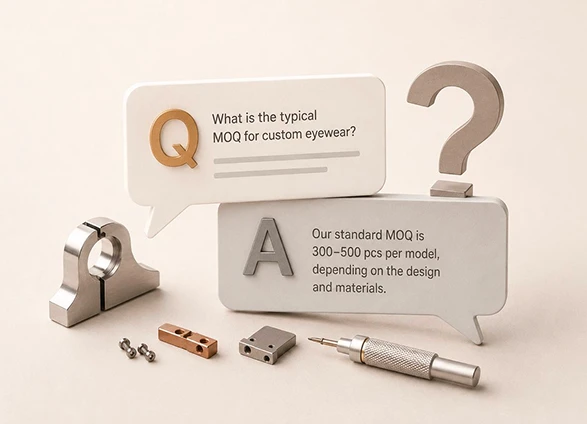
What is your MOQ for custom eyewear?

Our standard MOQ for OEM/custom production is 300 pieces per model. Whether a lower quantity is workable can only be confirmed after reviewing the design, materials, components, tooling and the minimum order requirements of the relevant suppliers. White Label quantities are assessed separately.

Can the MOQ be divided across colours or different models?

Colour allocation is reviewed within each model and depends on material, lens, plating and component minimums. There is no universal per-colour quantity for every construction. Different models do not automatically share one MOQ, even when they belong to the same collection.

Can we begin with 100–200 pieces for market testing?

Our standard custom-production MOQ remains 300 pieces per model. A smaller first run requires a design-specific assessment and is not automatically available. Where feasible, unit costs may be higher because engineering, setup, component procurement and quality-control work are spread across fewer pieces.

Can you make just a few frames for evaluation or a limited edition?

Development samples and commercial production are different scopes. A few prototypes can be discussed within a development project, but they do not establish a low MOQ for later production. Selected horn, silver or other special-material projects may have different batch economics and need individual review.

What does a premium OEM frame cost?

There is no single price for a premium frame. Acetate grade, metal construction, machining, hinges, lenses, plating and hand finishing can produce very different costs, even for similar-looking designs. Share a representative model and quantity so we can provide an indicative range with clear inclusions before preparing a formal quotation.

Why do you ask about our retail positioning and purchasing budget?

To establish whether our manufacturing approach is commercially suitable for your brand before either team invests in development. A retail position describes the intended product level; a purchasing budget identifies the workable cost range. We then assess material and craft choices within that brief. Retail price alone does not determine manufacturing cost.

What should be included in a complete project quotation?

The quotation should distinguish development, drawings, prototypes, tooling and bulk unit costs. It should also identify whether lenses, branding, finishing, packaging, testing and shipping are included or separate. Quantities, colour allocation, payment terms and delivery terms should be clear so your team can compare the total project cost, not just a headline unit price.

Will ordering 500 or 1,000 pieces substantially reduce the unit price?

Higher volume may improve setup and purchasing efficiency, but the effect depends on the design and colour mix. Premium materials, specialist components and manual finishing remain significant costs. We evaluate quantity tiers against the same specification; a lower price should not conceal a material or finish change.

Can you reduce cost without losing the intended quality?

We can review where the cost is concentrated and suggest alternatives—for example, component standardisation, available material colours or a simpler construction. The aim is to preserve the details that matter most to the brand. Any proposed change to materials, structure or finish needs review rather than an unapproved substitution.

What are your payment terms?

Sample work is normally paid in advance. Bulk orders typically use a deposit with the balance due before shipment. The applicable percentages, payment milestones, beneficiary details and any project-specific conditions are confirmed in the quotation, agreement and pro forma invoice before payment.

What happens between the first brief and mass production?

The usual sequence is brief review, feasibility assessment, technical drawings, sample development, refinement and final approval, followed by production, inspection and delivery preparation. Tooling and material procurement are planned around the design. Each stage should resolve the relevant technical and commercial questions before the project moves forward.

How much do drawings, prototypes and tooling cost?

These are assessed by model and development scope. A project needing new structure development, custom components or special craft trials requires different work from a frame with complete approved files. We confirm chargeable stages and deliverables in writing; one sample price should not be assumed to include every engineering or tooling requirement.

Does the sample fee include complete physical frames and revisions?

The development proposal should state the number of complete prototypes, their materials and finishes, included drawings, and the scope of revisions. Additional sample sets or a change of design direction may require extra work. Confirm these details before payment so both teams understand what will be delivered for approval.

Can sample or tooling fees be credited against a bulk order?

Sample-fee credits may be available under the project agreement, including a qualifying order quantity for the corresponding model. They are not automatic cash refunds. Tooling and other development charges are separate; any credit, refund or non-creditable item must be identified in the written proposal.

How long does development and sampling take?

Timing depends on technical readiness, materials, tooling, craft trials and the number of review rounds. We confirm the schedule after reviewing these requirements. Ask for separate milestones for drawings, the first prototype, revisions and final approval rather than treating the first sample date as the total development period.

What will we approve before bulk production starts?

Approval should cover the final drawings and dimensions, materials, colours, components, lenses, logo execution and finishing standard, together with the agreed physical sample. Any unresolved difference between the sample and intended production specification needs to be documented. Bulk production should follow the approved specification, not an earlier concept image.

What happens if we request changes during development?

The effect on drawings, samples, tooling, material orders, price and timing is reviewed first. Changes within the agreed scope and additional chargeable work need to be distinguished. Any extra work and cost should be agreed before it begins, with the updated specification clearly identified.

Can you develop different fits, sizes or weight targets?

Yes, these can be considered during engineering review. Bridge fit, temple length, frame width, balance and lens geometry need to work together. A thickness or weight target alone does not define comfort. Fit variants and additional sizes may require separate development, components or minimum quantities.

Do you need our physical sample, or are photographs enough?

Photographs and drawings may be sufficient for an initial assessment. A physical reference is more useful when the requirement depends on tactile finishing, fit, movement, colour or a precise assembly detail. We can advise whether sending it is necessary after reviewing the available information.

Which materials do you manufacture?

Our core OEM materials are acetate, titanium, stainless steel and combination constructions. Natural horn, 925 silver and 18K gold details are considered for selected projects. Material selection is reviewed together with the design, attachment methods, finishing requirements and production plan.

Which acetate suppliers and grades can we specify?

Mazzucchelli, Takiron and qualified local options such as JINYU can be discussed according to the project. The supplier name alone is not the complete specification: sheet grade, colour, pattern, thickness and availability also matter. Requested materials are confirmed against the construction, budget and procurement schedule.

What acetate thickness is best for a substantial premium frame?

There is no universal thickness. The front, temples, bridge and lens groove need different structural considerations, and final machining changes the weight and profile. We recommend thickness from the design, fit and intended feel rather than assuming that a thicker frame is automatically better quality.

Can you use bio-based or recycled acetate?

Relevant supplier options can be evaluated for your collection. Please define the material claim you want to make as well as the colour and performance requirements. Supplier documentation, availability and the suitability of the selected grade need review; an environmental claim should not be based on the word “bio” alone.

Do you manufacture TR90 frames?

No. We do not produce TR90 frames. Our core manufacturing focus is acetate, titanium, stainless steel and combination frames. If your collection can use these materials, we can review a suitable development direction.

Can you develop titanium and acetate-metal combination frames?

Yes. These constructions require coordinated dimensions, joining methods, hinge integration, surface preparation and final alignment. We review the material transitions and assembly tolerances early, because a convincing visual concept must also remain practical to manufacture and assemble consistently.

Can we specify premium hinges, screws, metal cores and nose pads?

Yes. Premium imported hinge options such as OBE or Visottica can be discussed, along with suitable local components. Barrel count is only one part of hinge selection; fit, attachment, opening action and compatibility with the frame also matter. Component specifications, availability and cost should be confirmed in the approved parts list.

Can we nominate our own material or component suppliers?

Please provide the supplier, exact part or material reference, technical information and expected availability. We can review compatibility with the frame and production process. Purchasing responsibility, incoming inspection, replacement arrangements and any effect on the schedule need to be agreed before development or production relies on those items.

What lens options can you provide?

Lens options can include nylon, CR-39, TAC, polarised options, solid or gradient tints and selected coatings. The choice depends on the frame geometry, optical requirements, target market and budget. Lens material, colour, coating and performance requirements should be specified separately rather than described only as “premium lenses”.

Can you provide polarised nylon lenses with UV400 and Category 3 specifications?

We can evaluate this combination for the proposed frame. Lens curvature, thickness, colour, coating, supplier availability and required test documentation need to be reviewed together. Polarisation, UV performance and filter category are separate requirements and should all be stated in the lens specification.

Can we request a specific lens supplier, colour or coating?

Yes. Named suppliers such as ZEISS and alternative lens options can be discussed for suitable projects, subject to availability and cost. Custom colours, gradients and coatings need sample review. A specific supplier or premium coating is not automatically included in a general frame quotation.

Do you make optical frames as well as sunglasses?

Yes. Please specify the intended use from the beginning. Optical frame development should include the relevant lens-fitting requirements, while sunglasses require an agreed lens specification. Prescription glazing services, if needed, must be discussed separately rather than assumed to be part of a frame order.

What does your premium acetate finishing process involve?

The route can include machining, forming, barrel processing, polishing, hand finishing, assembly and final adjustment. The sequence is selected for the material and geometry. Evaluation focuses on clean contours, smooth edges, consistent surfaces and accurate fitting—not an impressive-sounding fixed number of polishing stages.

How can we define the exact finishing standard we expect?

Use physical references and approved samples to establish gloss or matte effect, edge feel, contour definition, colour, plating appearance and assembly precision. Drawings and written criteria should support the sample where measurable requirements matter. This gives both teams a more useful benchmark than the phrase “luxury quality” alone.

Do you offer real gold plating or only gold-coloured finishes?

Real precious-metal plating and decorative colour finishes can be discussed for suitable projects. They are different specifications. The base material, coating process, colour, precious-metal content and layer thickness need to be agreed, together with the relevant performance expectations and cost.

Can you guarantee a finish will never fade or cause an allergic reaction?

We do not make blanket claims of permanent colour or universal allergy safety. The appropriate finish and verification requirements depend on the material, intended wear and target market. Durability testing, including corrosion or wear-related checks where relevant, can be discussed as part of the project specification.

Can you develop gemstone setting, enamel, natural lacquer or shell inlay?

Selected projects can be reviewed for these craft directions. We consider the design effect together with attachment, wear exposure, comfort and repeatability. Some specialist work involves dedicated partners, including jewellery expertise. Feasibility, craft samples and the required validation are established before committing to production.

Can we specify natural diamonds, lab-grown diamonds or other stones?

Please specify the required stone type, size, quality and documentation. Natural diamonds, lab-grown diamonds and alternatives such as moissanite should not be treated as interchangeable. Sourcing, setting feasibility and any individual or batch-level documentation need to be confirmed for the selected stones before quotation and approval.

Can natural horn frames be identical in colour and pattern?

Natural variation is part of horn’s character. A collection can have an agreed selection direction, but it should not promise the uniformity of a manufactured colour sheet. Colour range, pattern acceptance, finishing, care requirements and the role of natural variation should be discussed before sampling.

How do you keep production consistent with the approved sample?

Quality control includes material review, checks during production, final inspection and comparison with the agreed specification and sample. Critical features such as alignment, surface finish, component fit and marking need clear acceptance criteria. Consistency is built through the process rather than left solely to final inspection.

Can you work to our inspection checklist and quality limits?

Please share them during technical review. Measurement methods, tolerances, visual criteria, defect classifications and any sampling plan need to be aligned with the product and manufacturing route. Customer-specific inspection requirements should be agreed before production and included in the quality plan where accepted.

What tests and compliance documents can you provide for our market?

Testing and documentation are reviewed against the product, intended market and agreed specification. Please identify your destination markets and your technical team’s requirements early. We can then review available evidence, any additional testing and the responsibilities and costs involved. A generic certificate list is not a substitute for the documentation relevant to your actual product.

Can you provide current certification, audit and material records for vendor approval?

Send your supplier-qualification checklist so we can review the documents available for the relevant manufacturing scope. Any certificate, audit report or material record should be checked for its entity, scope, validity and relevance to the project. We do not assume that one document covers every material, process or finished product.

Can we use our own QC team or third-party inspector before shipment?

Yes, inspection arrangements can be discussed in advance. The inspection stage, reference samples, acceptance criteria, access requirements and reporting process should be agreed before the order reaches shipment. Any required corrective work and reinspection should be addressed within the agreed release process.

How do you verify material identity and manage substitutions?

The approved material specification and supplier references provide the starting point. Relevant supplier and batch documentation can be reviewed according to the project. If a specified material or component is unavailable, an alternative needs technical and commercial approval; it should not be treated as an invisible substitution.

What happens if delivered products do not meet the agreed specification?

Please provide the order and model references, affected quantities, photographs and a description of the issue. The case needs to be reviewed against the approved sample and agreed acceptance criteria. The remedy and responsibilities—including any rework or replacement—are determined under the supply agreement. Warranty scope, reporting periods and exclusions should be settled before ordering.

What is the difference between your Prestige, Core and Small-Batch routes?

The Prestige / Luxury Production Route addresses complex structures, special materials and additional refinement. The Core Production Route supports approved designs and repeatable production. The Flexible Small-Batch Route is for suitable pilot or early-stage projects. These describe how projects are planned and controlled, not a promise of a particular MOQ or three fixed levels of product quality.

How much production capacity can you allocate to our collection?

Available capacity depends on the material, model complexity, manual work, quantity and current schedule. Share your model list, colour plan and delivery requirements so the relevant workload can be assessed. A monthly output figure alone does not establish whether the factory can meet your particular collection’s timing and quality needs.

How long does mass production take after sample approval?

The production schedule is confirmed after reviewing the approved specification, material and component readiness, tooling, quantity and available capacity. Final sample approval is an important milestone, but it does not automatically mean every purchased item is ready. The plan should distinguish manufacturing completion from dispatch and arrival at your destination.

Can you work towards a fashion show or fixed launch date?

Share the required in-hand date at the start. We can assess the necessary decision, material, sample and production milestones against that deadline. A requested date is not a confirmed delivery commitment, and essential engineering or quality checks should not be skipped to recover time. Samples for an event and retail production may need separate plans.

How can we reduce delays and handle schedule changes?

Agree the specification early, consolidate sample feedback and identify long-lead materials before setting the launch plan. The project schedule should include approval deadlines and dependencies. If a change or supply issue affects delivery, its impact and available options need review before a revised commitment is made.

Can you support repeat orders and growth across several brands?

Repeat production starts from the approved specifications and relevant production references, with material availability and any changes reviewed for each order. For multi-brand programmes, model identification, artwork, approval authority and confidentiality need clear separation. Forecasts help planning, while capacity and delivery commitments still require order-specific confirmation.

Will the price and materials stay the same for future orders?

Not automatically. Material availability, supplier pricing, quantity, colour mix and tooling condition may change. A repeat-order review should identify any difference before confirmation. Longer-term purchasing plans and critical-material requirements are best discussed early rather than relying on indefinite availability.

Can you supply spare parts and support repairs?

Please include spare components and service requirements in the original brief. Suitable quantities of hinges, screws, nose pads or other model-specific parts can then be assessed with the order. Availability, cost and the support period need to be agreed; long-term component availability should not be assumed.

Can you arrange packaging and international delivery?

We specialise in eyewear. Packaging requirements can be coordinated with specialist packaging suppliers, with costs, minimums and sample approval considered separately. Shipping is assessed from the destination, packed volume and schedule. Freight, insurance, duties, taxes and the agreed delivery responsibilities must be clear in the quotation; a courier name alone does not define those terms.

Can we sign an NDA before sharing confidential designs?

Yes. We are open to reviewing an NDA before receiving confidential technical information. The agreement should provide practical protection for the information exchanged and the manufacturing activities involved. You can first share a non-confidential outline of the project to establish fit.

Who owns the designs, CAD files and tooling developed for our project?

Your existing designs and brand assets remain yours. Ownership and permitted use of newly developed drawings, CAD, tooling and other deliverables should be defined in the development agreement, including any pre-existing manufacturing know-how or standard components. Payment for development should not leave these boundaries unclear.

Can our designs and tooling be exclusive, and can we request their return?

Exclusivity, permitted use, storage, maintenance and any return or transfer arrangements need to be documented for the relevant project assets. Customer-specific designs and confidential materials should not be used for another client without authorisation. A selected existing design is not automatically exclusive, and tooling transfer needs a separate review of the agreed terms and practical requirements.

What does ANNEAL Japan add to a project?

For selected projects, Japan-side support may include refinement review, finishing assessment, selected adjustments, marking, final quality review and delivery preparation. The agreed scope depends on the product and schedule. It is an additional project-specific layer, not a replacement for Shenzhen engineering, manufacturing or production quality control.

Does Japan-side review mean the product is made in Japan?

No. Japan-side review or finishing support should not be presented as a blanket manufacturing-origin claim. The actual production route and supporting documentation must be considered before any origin marking is agreed. DOON does not describe all projects receiving Japan-side support as Japanese-made.

Is Japan-side support mandatory, and how does it affect cost and timing?

No. Projects can be planned with or without it. If relevant to your collection, the specific activities, logistics, schedule and additional cost should be evaluated at the beginning. Availability and involvement are confirmed for the project, not assumed to apply to every order.

What is the DOON Sample Box, and what does it contain?

It is a no-logo review toolkit for assessing manufacturing quality before custom development. The proposed set can combine a complete frame, frame parts, material and craft references, small components and practical inspection tools. Contents are selected for the review purpose and confirmed before arrangement; the box is not a promise that every displayed reference is included.

Is a Sample Box the same as a catalogue or an approval sample?

No. It helps your team assess material handling, structure and finishing. It does not establish stock availability, grant design exclusivity or replace a prototype made to your own approved specification. A production approval sample must reflect the requirements of the actual order.

How do we request a Sample Box, and what does it cost?

Share your brand background, target product level, material direction and what your team wants to evaluate. We can then review suitable references and confirm availability, contents, charges and shipping. It is not automatically a free sample programme, and it does not commit either party to production.

Do the concepts and craft examples in Insights represent orderable products?

Not necessarily. Insights includes manufacturing guidance, company updates and sample or craft explorations. A concept, including an AI-assisted visual, is not a production specification or an availability guarantee. Send the example you are interested in so we can discuss its relevance and the engineering needed for your project.

What should we send with our first enquiry?

Send your company or brand introduction, target markets, intended retail position, approximate purchasing budget, product references, material direction, number of models, quantity per model and target timing. Include technical files and quality requirements where available. If confidential, begin with a general brief and request an NDA before sending the full dossier.

Can we start without a public website or a complete technical package?

Yes. A concise brand brief can explain your target customer, sales channels, collection direction, price position and quantity plan. Make clear which decisions are already fixed and where you need development support. A complete website is not essential; a clear commercial and product direction is.

Can we arrange an online technical meeting or sample review?

Yes. Share your time zone, preferred dates, participants and the main questions you want to resolve. Sending the brief or permitted reference files beforehand makes the meeting more useful. Factory and exhibition meetings can also be discussed, subject to the relevant schedule.

What is the next step after we submit an enquiry?

We review the project’s commercial fit, design readiness, material direction and quantity requirements. The next step may be a clarification, technical meeting, sample review or scoped development proposal. A formal quotation follows sufficient technical definition; an initial discussion is not approval to begin chargeable work. Share your brand direction, technical readiness and production requirements. We will review the appropriate next step for your collection. Contact: Cherry@doon100.com · WhatsApp / WeChat: +86 135 5487 1667

Start with Clarity

Ready to discuss a premium OEM eyewear project?

Tell us about your brand positioning, target retail level, material direction, sample purpose, expected quantity and timeline. DOON will help evaluate the right OEM development and production route.