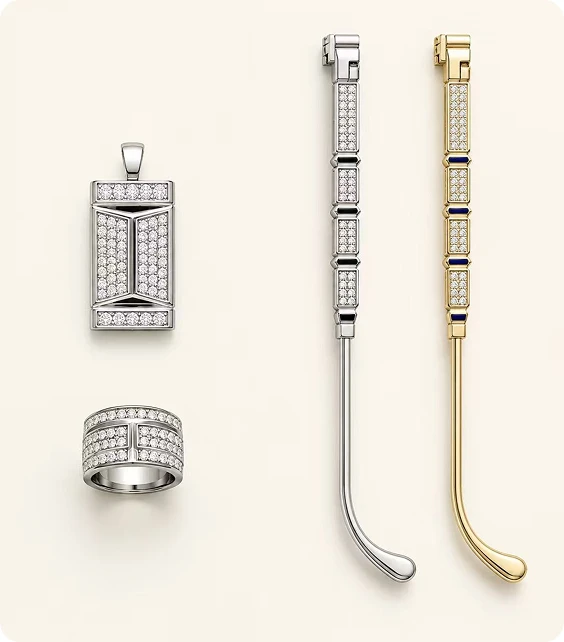
Our technical specification defines two main setting categories. The tolerances below refer to stone-size consistency within the relevant setting group.

TECHNICAL ARTICLE
Engineering specifications for glue-free mechanical setting
In premium eyewear, a gemstone setting must do more than create brilliance. It becomes part of a frame that is handled, folded, cleaned and worn repeatedly. For this reason, diamonds and moissanite are treated as engineering components within the eyewear structure, not simply as surface decoration.
The technical basis is a low-profile mechanical setting designed for daily wear. The objective is controlled stone retention, consistent alignment and a smooth finished surface that reduces snagging on hair or clothing.
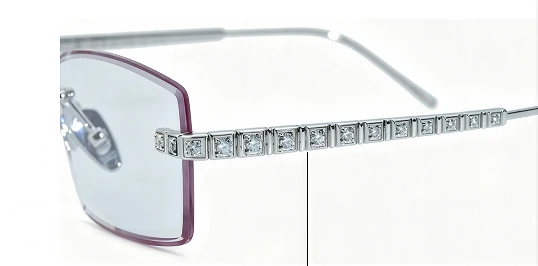
Completed eyewear sample: square stones mechanically set along the metal temple
Engineering Principle
The stone, seat and retaining structure are specified together. Seat geometry must support the stone evenly, while the retaining points must provide secure mechanical grip without creating local stress concentration in the frame component.
Core specification
100% glue-free physical micro-claw locking, with stone seats and retaining features produced by high-precision 5-axis CNC machining.
Glue-Free Mechanical Locking
No glue or adhesive is used in the setting structure. Micro-grooves, stone seats and retaining claws are machined into the component, allowing the stones to be held by physical contact and mechanical grip.
This construction avoids reliance on an adhesive layer between the stone and the frame. It also allows the retaining geometry, stone position and surface finish to be checked as defined technical features.
Setting Types & Precision Standards
Our technical specification defines two main setting categories. The tolerances below refer to stone-size consistency within the relevant setting group.
| Setting type | Stone tolerance | Technical requirement |
| Single / Pavé | Within ±0.05 mm | Precisely machined seats; even retaining pressure; control of local stress concentration. |
| Micro-Pavé / Starry Sky | Below ±0.03 mm | Closely matched stones with level tables; high-precision positioning; fine polishing after setting. |
Precision Requirements by Setting Type
Single and Pavé Setting
For a single stone or a repeated row, the seat must be matched to the stone dimension so that retaining pressure is distributed evenly. The specified size consistency for stones used in row settings is within ±0.05 mm.
Single and Pavé Setting
Micro-pavé uses smaller, closely spaced stones and therefore requires tighter dimensional matching. The specification sets stone-size tolerance below ±0.03 mm and requires level stone tables. Positioning may use 5-axis CNC or other high-precision equipment appropriate to the component.
After setting, fine polishing is applied to the surrounding metal and retaining points. The required result is a smooth, low-profile surface without sharp edges that may catch during normal handling or wear.
Micro-Pavé Setting
Micro-pavé uses smaller, closely spaced stones and therefore requires tighter dimensional matching. The specification sets stone-size tolerance below ±0.03 mm and requires level stone tables. Positioning may use 5-axis CNC or other high-precision equipment appropriate to the component.
After setting, fine polishing is applied to the surrounding metal and retaining points. The required result is a smooth, low-profile surface without sharp edges that may catch during normal handling or wear.
Technical Parameters at a Glance
| Item | Specified value |
| Adhesive in setting | None |
| Single / pavé stone consistency | ±0.05 mm |
| Micro-pavé stone consistency | < ±0.03 mm |
| Primary retention | Mechanical micro-claw / machined retaining structure |
Verification & Durability Specifications
The setting is evaluated as part of the finished eyewear component. Our technical specification defines the following environmental, vibration and surface-performance checks.

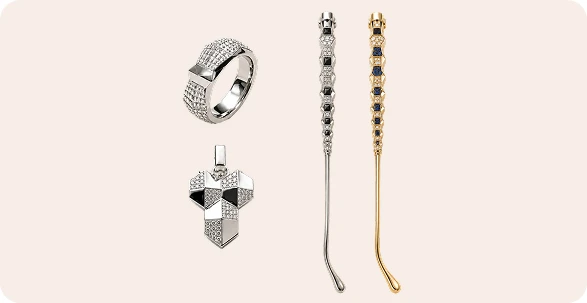
Completed eyewear sample: coloured stones set in a repeating temple structure.
| Verification item | Specified value |
| Thermal shock | Temperature change from –20°C to 60°C; the setting is checked for loosening after exposure. |
| Ultrasonic fatigue | 30 minutes of continuous high-frequency vibration in professional ultrasonic cleaning equipment. |
| Artificial perspiration / corrosion | 24-hour project specification; appearance and coating condition are checked after exposure. |
| Coating hardness | HV 400+ as specified for the metal coating. |
Batch Verification & Project Records
Batch-Level Verification for Melee
For orders using small natural diamonds, batch-level screening or third-party verification can be arranged according to the order specification. GIA, for example, lists batch services that include its Melee Analysis Service. The selected laboratory, sample quantity and report format should be agreed for the project.
Official References
ISO 12870:2024 — Ophthalmic optics — Spectacle frames — Requirements and test methods: https://www.iso.org/standard/75916.html
Kimberley Process FAQ — scope of KPCS and the System of Warranties: https://www.kimberleyprocess.com/faq
GIA Diamond Grading Report Services — Batch Services and Melee Analysis Service: https://www.gia.edu/gem-lab-service/diamond-grading-report-service
Review the finished samples at SILMO Paris
Hall 6 · Booth C139 | More setting techniques and project specifications available by appointment.
Previous:
NoneNext:
Natural Lacquer
Copyright @ DOON EYEWEAR (SHENZHEN) TECHNOLOGY CO., LTD All Rights Reserved |
Sitemap
| Powered by